Poly mailer vs paper mailer
Paper reads as the responsible choice and it is sometimes the wrong one. The comparison that matters is not plastic against paper — it is total shipment cost, damage rate and which recycling stream the pack realistically reaches, and those three do not all point the same way.
Where paper genuinely wins
There are two arguments for paper that hold up under scrutiny, and they are strong ones.
Kerbside recycling is real and available. Paper mailers go into a household paper stream that exists in essentially every developed market. Poly mailers are recyclable in principle but need a store drop-off or a soft-plastics scheme, and participation in those is low. If your measure is what actually gets recycled rather than what could be, paper wins that comparison outright.
Customer perception. Paper is read as sustainable at a glance, without a label or an explanation. For a consumer brand that is worth something real, whatever the underlying life-cycle arithmetic says.
The caveat on both: a paper mailer with a plastic bubble lining or a plastic window is not paper-recyclable. If you go paper, go paper all the way through, including the tape, or you have bought the cost without the benefit.
Where poly genuinely wins
Three of these are measurable, and one of them shows up on every freight invoice.
Weight. A poly mailer is substantially lighter than a paper equivalent of the same size. With carriers pricing on dimensional or actual weight, that difference is charged on every parcel you ship, every day, for as long as you ship it. On high volumes it is frequently the largest single number in this comparison.
Water. Poly is waterproof. Paper is water-resistant at best, and a coating that makes it genuinely waterproof usually makes it non-recyclable. If your parcels are left on doorsteps, this is a damage-rate difference, not a preference.
Tear and puncture resistance. Co-extruded PE mailers stretch before they tear. Paper tears from a nick. Where parcels are handled roughly or contain anything with a corner, the damage rate difference is visible in returns data.
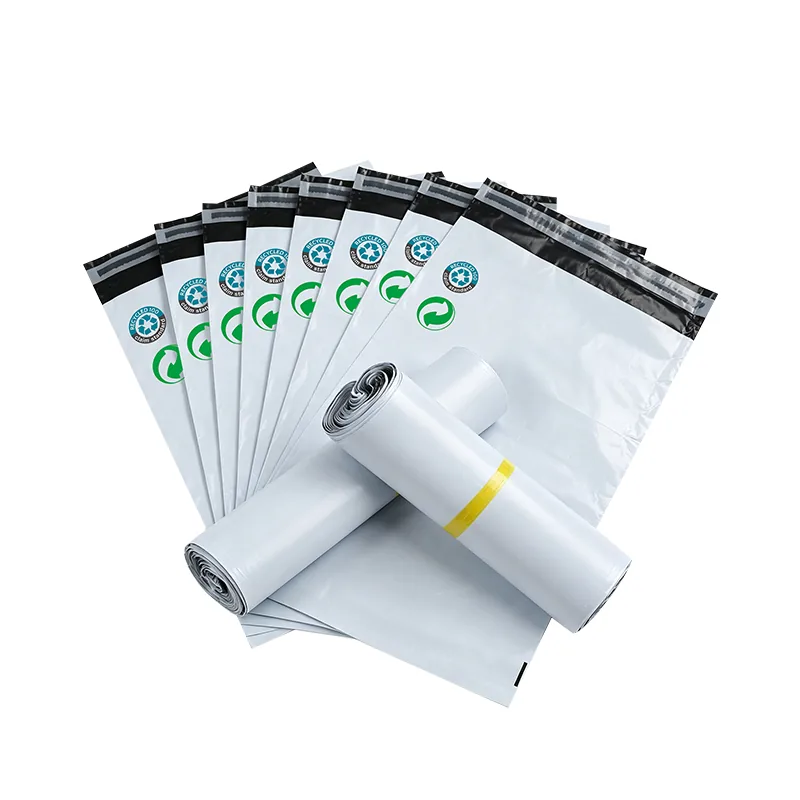
Recycled content is easier. A poly mailer can carry a high proportion of post-consumer recycled polyethylene without changing how it performs. Recycled paper content is normal too, but the strength penalty for high recycled content is more noticeable in paper.
The comparison people forget: total cost per shipment
Unit price is the wrong number. The right one has four terms and only one of them is what you pay the packaging supplier.
- Pack cost — paper mailers are typically more expensive per unit than poly of equivalent size.
- Shipping cost — driven by weight, and this is where poly recovers a great deal.
- Damage and replacement — the cost of a damaged item is the item plus a second shipment plus the customer-service handling, so even a small rate difference carries a large multiplier.
- Tax and compliance — under a plastic packaging tax, poly below the recycled-content threshold carries a charge that paper does not. Above the threshold, it does not.
Run those four for your own volumes before deciding. A brand shipping soft goods in dry climates and a brand shipping boxed electronics to doorsteps in winter will get opposite answers from the same arithmetic, and both will be right.
What we would specify, product by product
Since the honest answer is that it depends, here is what it depends on.
- Apparel and soft goods, high volume — poly mailer with high PCR content. Weight saving compounds, damage risk is low, and the recycled content answers the tax.
- Books, stationery, flat rigid items — paper mailer. Weight penalty is small relative to the contents and the rigidity suits the format.
- Anything with corners or edges — poly, or paper with a genuine protective layer and the recycling compromise that comes with it.
- Cosmetics and liquids — poly, for the water resistance in both directions.
- Plastic-free brand promise — paper, or a certified compostable mailer, and be sure the tape matches the claim.
Common questions
Are paper mailers actually better for the environment?
It depends which measure you use. Paper wins on realistic end-of-life recycling. Poly frequently wins on production energy and on transport emissions, because it weighs less. Anyone claiming one is simply better is skipping half the comparison.
Can poly mailers be recycled?
Technically yes, as a soft plastic. Practically it needs a store drop-off or a soft-plastics collection scheme, and participation is low. Recycled content going in is a more reliable benefit than recycling coming out.
Do paper mailers cost more?
Per unit, usually yes. Per shipment, not necessarily — you have to add the shipping-weight difference and the damage rate before the comparison means anything.
What about compostable mailers as a third option?
They are a genuine option where the brand position calls for it and where an industrial composting route exists. They cost more than either paper or poly and offer less puncture resistance than poly.
Where to go next
- PCR poly mailers
- UK Plastic Packaging Tax: how the 30% threshold works
- Send us a specification
- Poly mailer size and cost guide
- Reusable bag materials: nonwoven, rPET, cotton
- PCR vs compostable vs mono-material
We answer every enquiry within 12 hours and issue a detailed quotation within 24 hours. Send us a specification.