EU PPWR: what packaging buyers must change before 2030
The Packaging and Packaging Waste Regulation replaced a directive with a regulation — it applies directly in every member state, with no national transposition to wait for. For flexible packaging that means three obligations arriving on a fixed timetable, and one of them needs specification changes years ahead of the deadline.
What actually changed
A directive tells member states what outcome to reach. A regulation binds you directly. That single legal change is why PPWR moves faster than anything in packaging compliance since REACH — there is no twenty-seven-way national interpretation to hide in, and your German, French and Spanish customers will all be asking the same questions in the same quarter.
Three obligations matter for flexible packaging:
- Recyclability grading — every packaging unit must be design-for-recycling assessed and graded. Below the passing grade, it cannot be placed on the EU market.
- Minimum recycled content — binding percentage minimums for plastic packaging, rising on a set schedule, with contact-sensitive applications treated separately.
- Waste and reuse targets — per-capita packaging waste reduction, plus reuse obligations concentrated in transport and grouped packaging.
Add the empty-space rule and the labelling harmonisation and you have a regulation that touches the specification, the artwork and the pack format at the same time.
Why recyclability grading is the one to act on first
Recycled content can, in principle, be bought. Recyclability has to be designed in — and if your current structure fails, you are looking at a requalification cycle, not a purchase order.
Most flexible packaging on the EU market today is multi-material laminate: PET outer for print and stiffness, aluminium or metallised layer for barrier, PE inner for sealing. It performs beautifully and it is close to unrecyclable in a standard sorting stream, because no mechanical process can economically separate those layers again.
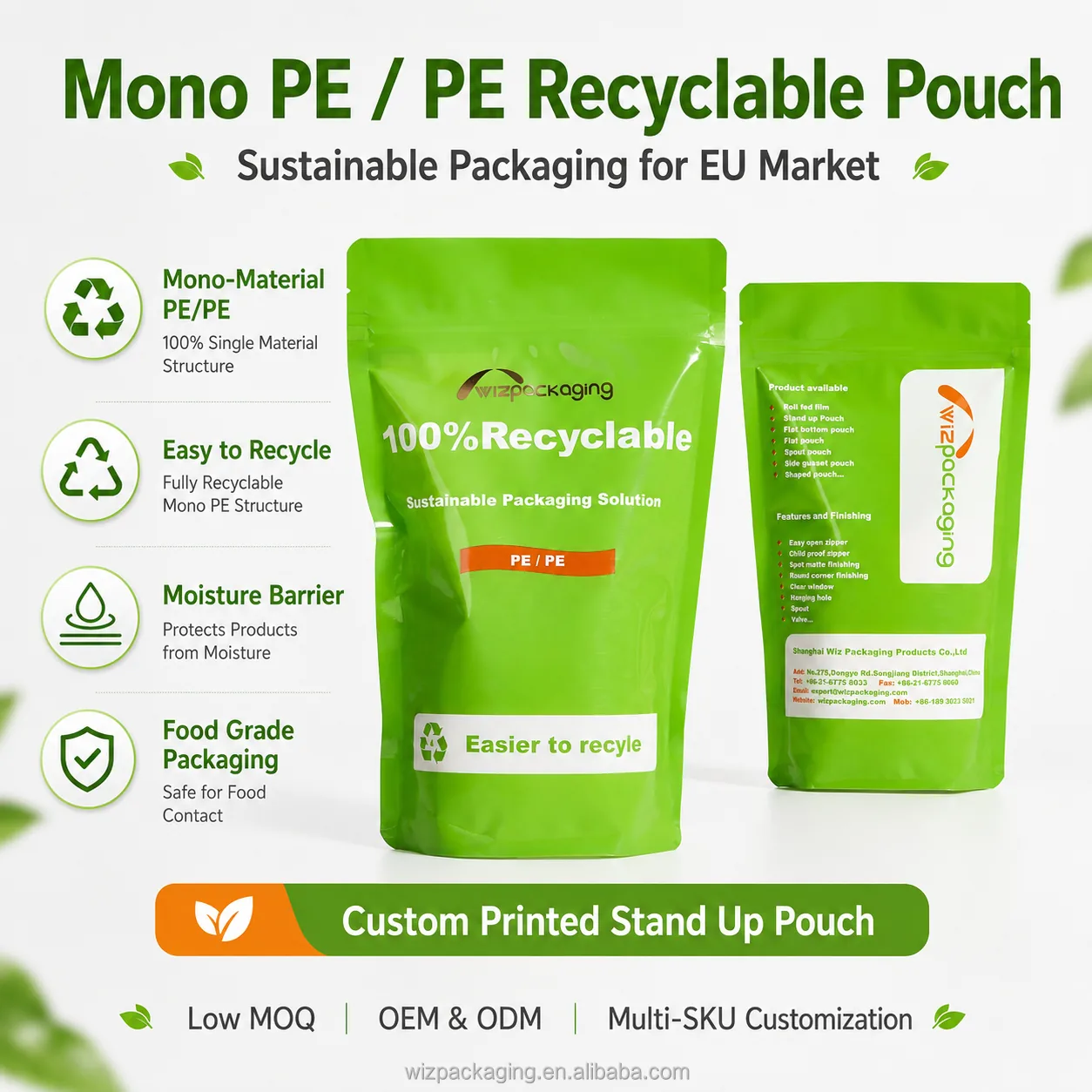
The design-for-recycling answer is mono-material: build the whole structure from one polymer family, usually PE or PP, so it drops into an existing recycling stream intact. The engineering problem is that you are asked to replace PET's stiffness and printability, and the metallised layer's barrier, using only PE.
It is solvable. Oriented PE films now give the stiffness and print surface that PET used to provide. Barrier comes from high-barrier coatings or EVOH content kept low enough that the structure still counts as mono-material under the relevant design guidelines. The result is a pouch that runs on your existing filling line, passes design-for-recycling assessment, and looks the same on shelf.
What it costs you is time. A mono-material conversion means new film trials, new seal-parameter windows on your filler, fresh shelf-life data, and in a food application a repeat of your migration testing. Twelve to eighteen months from first sample to full changeover is normal. Counting backwards from the deadline is why this is the first thing to start, not the last.
Recycled content: where it gets hard
The recycled-content minimums are the part buyers usually assume they can solve at the last minute. Two things make that assumption expensive.
Food contact is the bottleneck. Mechanically recycled polyolefin is not generally authorised for direct food contact in the EU the way recycled PET is. For a food-contact flexible pack, the recycled content usually has to sit in a layer that does not touch the product, with a functional barrier in between. That constrains the structure before you even start negotiating percentages.
Supply is not evenly available. Post-consumer recyclate that is clean enough, consistent enough in melt flow and colour, and available in the tonnage a real programme needs, is a genuinely constrained market. Buyers who leave it late discover that the price of certified PCR moves with the deadline.
We run 30% to 70% post-consumer recycled content as stable, repeatable production rather than as a one-off sample — the honest ceiling on a demanding film, not the 100% figure the industry advertises. GRS certification provides the chain of custody your customer's auditor will ask for. See how the PCR structures are built.
A practical sequence
- Inventory your structures. List every packaging specification you place on the EU market and mark each as mono-material, laminate, or unknown. The unknowns are usually the problem.
- Get each one assessed against design-for-recycling criteria. Your supplier should be able to tell you where a structure fails and what changing it costs.
- Start the hardest conversion first. The highest-barrier, longest-shelf-life pack is the one that will take the longest to requalify.
- Lock recycled-content supply early, with certification, rather than assuming spot availability.
- Align the artwork changes with the structural change so you pay for one plate set, not two.
Send us the structure you are worried about and we will tell you what a mono-material or PCR version looks like — thickness, barrier, seal window and the tooling implications — before you commit to a trial.
Common questions
Does PPWR apply if I only sell into one EU country?
Yes. PPWR is a regulation, not a directive, so it applies directly in every member state without national transposition. Selling into a single EU market gives you no exemption.
Can recycled content be used in food-contact flexible packaging?
Not usually in the layer touching the food. Mechanically recycled polyolefin is not generally authorised for direct food contact in the EU, so recycled content is normally placed in an outer layer behind a functional barrier. The structure has to be designed around that constraint.
How long does a mono-material conversion take?
Typically twelve to eighteen months from first sample to full changeover, covering film trials, seal-parameter validation on your filling line, shelf-life data and, for food applications, repeat migration testing.
Where to go next
- Mono-material and laminated structures
- PCR recycled-content film
- Certifications and compliance
- EN 13432 vs ASTM D6400 compostable standards
- UK plastic packaging tax and recycled content
- PCR vs compostable vs mono-material
We answer every enquiry within 12 hours and issue a detailed quotation within 24 hours. Send us a specification.